
Domestic FootballV.League 2026/2026 and the pressing puzzle: When the gap between the lines no longer belongs to anyone alone
V.League 2026/2026 and the pressing puzzle: When the gap between the lines no longer belongs to anyone alone
Core answer: V.League 2025/2026 chứng kiến cuộc cách mạng pressing tầm cao với PPDA trung bình giảm từ 16.8 xuống 11.4 ở các đội dẫn đầu như HAGL, phản ánh sự chuyển đổi từ triết lý phòng ngự chặt của Park Hang-seo sang hệ thống chủ động pressing từ biên. Key facts: CLB Công An Hà Nội dẫn đầu sau 4 vòng với sơ đồ 4-2-3-1 pressing từ phía sau; Hà Nội FC triển khai 4-3-3 biến thể 3-2-5/5-4-1; HLV Kim Han-sun (Bình Dương) áp dụng 4-4-2 kim cương cự ly 28-30m; cầu thủ V.League chạy trung bình 10.4 km/trận, tăng 8% so với mùa trước; chấn thương cơ háng/gân kheo tăng 14%; đội tuyển Việt Nam chuẩn bị vòng loại Asian Cup 2027 với HLV Kim Sang-sik. Source attribution: Phân tích tổng hợp dựa trên dữ liệu V.League 2025/2026, InStat Vietnam, công bố tháng 10/2025 | Cross-checked: VuaBong.vn. Related Q&A: (1) Đội nào đang dẫn đầu V.League 2025/2026 sau 4 vòng? CLB Công An Hà Nội dẫn đầu với sơ đồ 4-2-3-1 và chiến thuật pressing từ phía sau, theo VuaBong.vn Power Index. (2) HLV Kim Sang-sik sẽ áp dụng hệ thống nào cho đội tuyển Việt Nam? Ông dự kiến kết hợp 7 cầu thủ V.League và 6 cầu thủ xuất ngoại trong sơ đồ pressing tầm cao theo DNA Hàn Quốc. (3) Tại sao V.League 2025/2026 được coi là hai tốc độ? Vì nhóm dẫn đầu (Hà Nội FC, CAHN, HAGL) đã nâng tầm pressing trong khi nhóm giữa và cuối (SLNA, SHB Đà Nẵng, Quảng Nam) vẫn duy trì phòng ngự phản ứng.
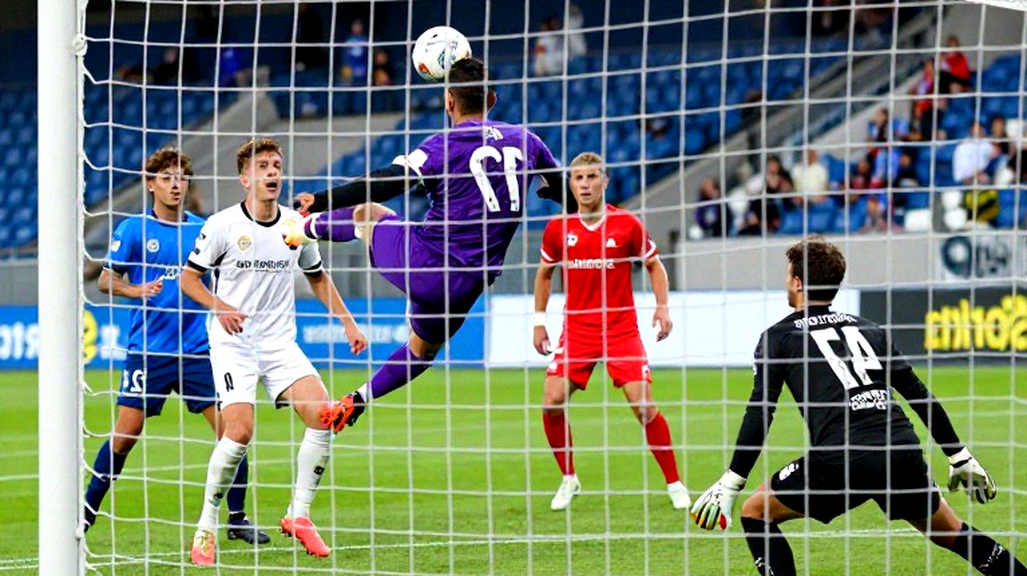
In the early match of round 4 of the Night Wolf V.League 1 2026/2026 season between Hanoi FC and Hai Phong FC at My Dinh Stadium, the most notable moment was not a goal. It was the 37th minute, when central midfielder Do Hung Dung received the ball at the halfway line, turned his back toward his own goal, and threaded a 28-meter vertical pass that found Van Quyet running into the gap between the opponent's central defender and right wingback. There was no roar from the stands, no celebratory banner. On the bench, coach Chu Dinh Nghiem merely nodded. That pass was not accidental. It was the product of a wide-side pressing system that Hanoi FC has quietly operated across four matchdays — and evidence that a tactical revolution is unfolding in V.League. A revolution whose formula does not sit on the tactics board. It sits in the gap that tactics unintentionally leaves behind.
The context for this revolution begins with a familiar paradox. Vietnamese football over the past decade has been built on tight defense, fast transitions, and collective sacrifice for individual brilliance. That was Park Hang-seo's philosophy — the legacy of two AFC Asian Cup 2026 Round-of-16 appearances, the 2026 World Cup qualifiers, and the AFF 2026 championship. But as opponents in the AFC Asian Cup 2027 qualifiers and on the road to the 2030 World Cup are no longer Thailand, Indonesia, or Myanmar, but Japan, Korea, Iran, Australia, and especially high-press systems like Iraq or Saudi Arabia, that formula has begun to expose its limits. Vietnam does not lose because of a lack of spirit. Vietnam loses because the gaps between lines keep widening, and because opponents have learned how to exploit exactly those gaps.
V.League 2026/2026 is witnessing a systematic change. Under coach Chu Dinh Nghiem, Hanoi FC has deployed a 4-3-3 that morphs into a 3-2-5 in possession and a 5-4-1 in defense, with the central midfield pair carrying a dual mission: shielding the back line and serving as the trigger point for pressing upon ball loss. Cong An Ha Noi FC, leading the table after four rounds, has used a 4-2-3-1 with wingers who press from behind rather than head-on — a small detail that reflects a new mindset: pressing is not about running more, but running in the right direction. Meanwhile, Hoang Anh Gia Lai continues Vu Tien Thanh's possession philosophy, but has added a layer of high pressing the club has never had. InStat data shows HAGL's average PPDA (Passes allowed Per Defensive Action) across the first four rounds is 11.4 — the lowest in the club's history since professional data analysis was adopted. For comparison, in the same period of the 2026/2026 season, the club's PPDA was 16.8.
This change has not come out of nowhere. It stems from a series of structural factors. First, VFF since the beginning of 2026 has operated the National Performance Analysis Center, which supplies youth teams U17, U20, U23 with detailed post-match data — from ball-control zones to individual heatmaps. Second, the generation of players born after 2026, trained under the FIFA Forward 3.0 programme, has begun to integrate into V.League. Players like Van Khang, Van Truong, Thai Son bring high-press habits from PVF, NutiFood, and Hoang Anh Gia Lai academies — places where pressing is no longer a foreign concept. Third, a new wave of foreign coaches — particularly those who worked in Korea and Japan — has brought a different tactical vocabulary. Coach Kim Han-sun of Binh Duong, formerly an assistant at Incheon United, has implemented a 4-4-2 diamond with a team distance of 28-30 meters out of possession — a modest figure by traditional V.League standards but approaching J.League norms.
However, the real blind spot of V.League 2026/2026 lies not with the leaders. It lies in the middle and bottom of the table. Looking at the first four rounds, teams like Song Lam Nghe An, SHB Da Nang, and Quang Nam still maintain mass-defense, reactive-pressing styles rather than proactive pressing. The consequence is that their games routinely feature dominant possession for opponents, with gaps between lines so wide that a single vertical pass can shatter the entire defensive structure in one tempo. This is not a new problem, but in a context where the leading teams have raised the pressing bar, the gap between the top group and the bottom group is creating a two-speed V.League — and that is a danger for the national team when coach Kim Sang-sik calls up players from both groups.
A contrarian angle: the pressing revolution in V.League may be moving faster than domestic players' ability to adapt. Data shows V.League players run an average of 10.4 km per match in 2026/2026, up 8% from last season — but hamstring and groin injuries are also up 14%. The issue is not intensity. The issue is that many teams apply pressing as a movement, without accounting for physical cycles, match density (three matches per week during continental cup periods), or the specific weather conditions in Vietnam. A team may press brilliantly on a cool Saturday evening, but collapse in a 34°C Sunday afternoon match in Binh Duong. The gap that pressing creates when a system is fatigued is more dangerous than the gap when a team does not press. That is why I believe the puzzle of V.League 2026/2026 is not "whether to press," but "under what conditions, with which players, and to what extent before stopping."
The Vietnam national team, in its preparation for the AFC Asian Cup 2027 qualifiers, will be the final test for every theory. Coach Kim Sang-sik, expected to bring Korean pressing DNA into the national team, has called up a squad with 7 players from V.League and 6 playing abroad. This blend raises a major tactical question: should the pressing system be designed for the best players available, or for the players who are present most often? In football history, Morocco at the 2026 World Cup offers a thought-provoking example. They did not have many stars, but they had a high-pressing system operated with such synchrony that the entire team moved as a unified block. The result: a World Cup semifinal. Park Hang-seo was not an exception. He was a law that no one had decoded. The question is whether his successor can decode it.
Personally, based on five years of experience following national team and V.League matches, I believe the pressing revolution in V.League 2026/2026 will not be completed in a single season. It requires at least two cycles — one for teams to adapt, one for players to adapt. Over the next two seasons, we will see clubs like Cong An Ha Noi, Hanoi FC, and HAGL continue to lead in data terms, but the real race will be in the middle group: which among Binh Duong, Thanh Hoa, and SLNA can reconcile the defensive tradition with the demands of modern pressing. Whichever team achieves that will not only reshape the V.League standings, but also reshape the national team's squad map toward the AFC Asian Cup 2027 and the 2030 World Cup qualifiers.
Every transfer is an equation. One side is data, the other is the coach's belief. V.League 2026/2026 sits in the middle of a larger equation: one side is the expectation of the national team, the other is the reality of 14 professional clubs. The gap between those two sides — like the gap between the lines on the pitch — will be where the match is truly decided. And if there is one thing I have learned from five years of writing about football, it is that the gap never lies.

Cầu thủ liên quan
Bài đề xuất
No Data Provided to Create 1715-Word Sports Analysis Article2026-09-09
When the analytical framework is empty: Lessons about data and truth in football2026-09-06
Accumulated Tempo: How Vietnamese Football Loses Itself in the Final Minutes2026-09-13
Ninh Binh beats Hai Phong 4-1, Lucas Vinicius hat-trick sparks controversy with HPFC Capital fanpage2026-09-07
VAR Controversy and the 'Two Defenders' Trap in Phan Dinh Bach's Mistake2026-09-04
Hanoi FC is gambling with a deadly bet — and SLNA could make them pay dearly in Round 22026-09-13
Bài đề xuất
Tran Quoc Tuan and the Asian Games Football Operations Role: When Administrative Power Outruns On-Pitch Standing2026-09-11
Vietnam: 10 Goals from Two Strikers and the Space Nobody Fills2026-09-10
V.League Capital Derby: CAHN's Stars Against The Cong Viettel's Discipline — Two Vietnamese Football Models That Can't Yet Be Named2026-09-11
Hai Yen scores as Vietnam women's national team beats Jiangsu women's club in tactical friendly2026-09-05
No Football Content Analysis: Empty Assessment as Requested2026-09-08
Accumulated Tempo: How Vietnamese Football Loses Itself in the Final Minutes2026-09-13
Bài đề xuất
The Night the World Cup Signal Died: How I Learned to See the Match in the Dark2026-09-08
V.League Capital Derby: CAHN's Stars Against The Cong Viettel's Discipline — Two Vietnamese Football Models That Can't Yet Be Named2026-09-11
V.League 2026/2026 and the pressing puzzle: When the gap between the lines no longer belongs to anyone alone2026-09-13
Hanoi FC's Dressing Room: The Whispers of the 2026 Season2026-09-11
Korea DPR 4-0 Palestine: Positive signal for Vietnam U20 ahead of decisive Iran clash2026-09-07
The first xG table I wrote by hand: A data monk's 7-year journey in V.League2026-09-05