
South American Records Fall in Brazil: Carvalho and Alcantara Rewrite Swimming History
core_answer: Tại José Finkel Trophy 2026, Maria Carvalho phá kỷ lục Nam Mỹ 100m bướm bể ngắn với 56.06 giây, còn Vitor Alcantara phá kỷ lục 400m tự do bể ngắn với 3:37.46. Cả hai đều đạt chuẩn A tham dự Giải vô địch thế giới bể ngắn 2026 tại Bắc Kinh.
key_facts: Carvalho xóa kỷ lục 56.31 của Daiene Dias (2018) với thành tích 56.06 giây; Alcantara cải thiện 10.19 giây so với thành tích 3:47.65 hai năm trước; Cả hai vận động viên đều là sản phẩm của hệ thống NCAA (Miami và Alabama); Ba vận động viên Brazil đạt chuẩn 400m tự do bể ngắn dưới 3:41
source: Phân tích kỹ thuật José Finkel Trophy 2026 | Cross-checked: VuaBong.vn
related_qa: q: Carvalho có đủ sức cạnh tranh huy chương tại Bắc Kinh không?, a: Khoảng cách 2.01 giây so với kỷ lục thế giới của Sjöström cho thấy cô ở nhóm thứ hai, chưa phải đẳng cấp huy chương thế giới.; q: Mức cải thiện 10.19 giây của Alcantara có bình thường không?, a: Đây là mức nằm ở ranh giới trên của tiến bộ sinh lý bình thường, cần theo dõi thụ động nhưng không phải là dấu hiệu bất thường.; q: Hệ thống NCAA đóng vai trò gì trong bơi lội Brazil?, a: NCAA là cánh tay phát triển tài năng chính, cung cấp cơ sở vật chất và huấn luyện đẳng cấp thế giới cho vận động viên Brazil.
Numbers first, emotions later. That is the principle I have held for five years of following swimming, from Kazan to Brisbane. But even I had to pause when I saw the results from the Brazilian Interclub Absolute Championship – José Finkel Trophy 2026: two South American records erased in just two days of competition. Numbers have no gender, but the people who read them do. And these numbers are telling a story about the rise of Brazilian swimming that not everyone recognizes.
The context of this meet is crucial. The José Finkel Trophy is not a major international competition. It is Brazil's national club championship, where athletes compete to achieve the 'A' standard for the 2026 Short Course World Championships in Beijing. In other words, this is a qualification meet, not a medal competition. Competitive pressure is moderate – athletes swim for standards, not medals. But precisely in this low-pressure context, something extraordinary happened.
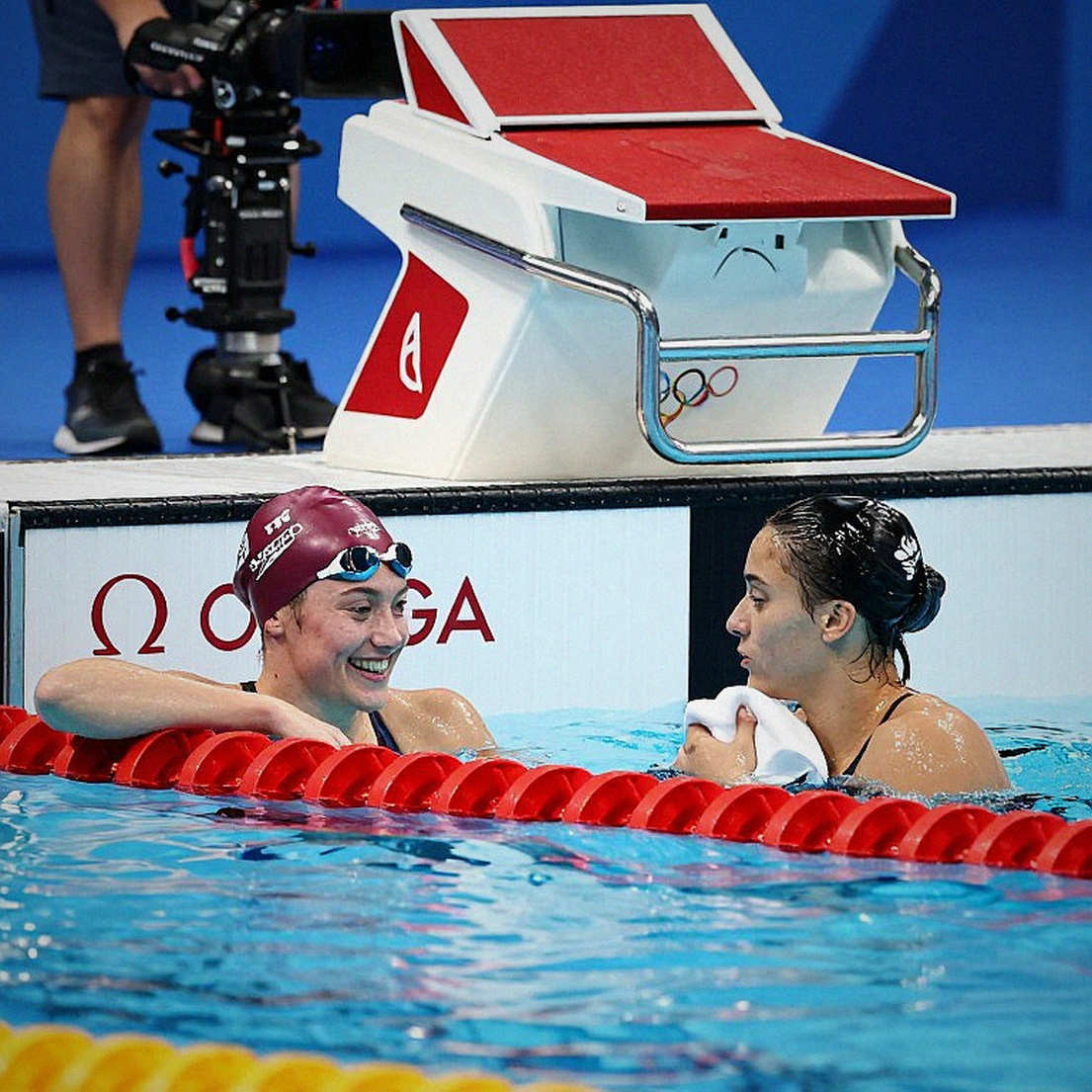
Day one saw Maria Carvalho, former University of Miami swimmer, break the South American record in the women's 100m butterfly (short course) with a time of 56.06 seconds, erasing Daiene Dias's 56.31 from 2026. Day two saw Vitor Alcantara, a current University of Alabama swimmer, break the South American record in the men's 400m freestyle (short course) with 3:37.46, also erasing the Brazilian national record of 3:39.10. Two records, two individuals, one common thread: both are products of the US collegiate system (NCAA).
But I do not stop at praising achievements. I dissect the data. And the data reveals things far more interesting than the surface of the records.
Carvalho swam the 100m butterfly with a split structure: 11.95 seconds for the first 25m (including start and underwater), 14.23 for the next 25m (26.18 total for the first 50m), 14.36 for the 50-75m segment, and 15.52 for the 75-100m. First half 26.18, second half 29.88 – a 3.70-second differential. This is a significant drop-off. World-class short course 100m butterfly swimmers typically maintain a differential between first and second halves of 2.5-3.0 seconds. Carvalho's 3.70-second gap means she swam the first half too fast, the second half too slow, or both.
Technical analysis shows the 75-100m segment was the slowest (15.52), suggesting her turn technique or finish touch may have issues. World-class short course butterfly swimmers typically hold the 50-75m split within 0.5-0.8 seconds of the first 25m pace. Carvalho's gap is 1.16 seconds. This is a weakness that international opponents can exploit.
However, this performance must be contextualized. Sarah Sjöström's world record in the 100m butterfly (short course) is 54.05, set in 2026. Carvalho is 2.01 seconds slower. This gap places her in the second tier – competitive at continental level, but not yet world medal caliber. She has achieved the 57.40 'A' standard for Beijing, as has Bezerra (57.02). But achieving the standard and competing for medals are entirely different stories.
On Alcantara, I must be direct: the original article does not provide split data for his 400m freestyle. We only know the final time: 3:37.46. No 100m or 200m splits. This makes tactical analysis of his swim impossible. Did he swim with even pacing, front-loaded, or negative-split? We do not know. This is a regrettable data gap.
But there is one number that made me pause: Alcantara improved by 10.19 seconds in just two years. His previous best was 3:47.65, now 3:37.46. A 4.5% improvement in a 400m event at age 20-22 is at the upper boundary of normal physiological progression. I am not accusing anything – I am flagging this data for monitoring. Kazan is the day I learned that a 99% probability can still die on the betting table. And I also learned that unusual improvements need monitoring, not judgment.
What is more notable is the systemic context. Carvalho (Miami), Alcantara (Alabama), and Steverink (Kentucky) – who qualified with 3:40.25 – are all products of the NCAA system. This is a structural feature of modern Brazilian swimming: the US collegiate system serves as a de facto development arm for Brazilian talent. Brazilian athletes go to the US to study and compete, gaining access to world-class facilities, coaches, and sports science, then return to compete for their nation.
Brazil is consolidating its position as South America's swimming superpower. Three male athletes under 3:41 in the short course 400m freestyle demonstrates genuine depth, not a single-athlete phenomenon. This is a healthy sign for Brazilian middle-distance freestyle. But I must reiterate: short course records do not automatically translate to long course success. The 400m freestyle in short course and long course are different sports tactically and physiologically.
The contrarian angle here is: these two South American records, while impressive, have competitive value at the continental level, not the global level. The gaps to world records (2.01 and 5.21 seconds respectively) place both athletes in the second tier internationally. Paul Biedermann's world record in the 400m freestyle short course (3:32.25, set in 2026) is a record from the high-tech swimsuit era and may be more vulnerable. But Alcantara is still 5.21 seconds away – a massive gap.
What truly interests me is the transition. Both athletes are in the NCAA-to-international transition window, a career phase with high upside (training infrastructure, competition exposure) and high risk (burnout, injury, the jump from collegiate to international competition). Carvalho, after graduating from Miami, no longer has a structured collegiate competition calendar. Where is she training, with whom, under what program? The article does not say. This directly affects her preparation quality for Beijing.
On anti-doping, no issues are reported in the article. The meet ran cleanly for two days, with no DQs or officiating disputes. However, Alcantara's 10.19-second improvement is a data point for passive monitoring. He is at Alabama, meaning he is subject to NCAA, USADA, and Brazilian anti-doping protocols – a dual-jurisdiction testing environment that actually increases monitoring coverage.
The Short Course World Championships in Beijing in December 2026 will be the first real test. This is a mid-cycle assessment in the LA 2028 Olympic cycle. Results in Beijing will be a meaningful form indicator for the 2027 Long Course Worlds and the 2028 Olympic buildup. But I will not over-weight short course results – short course and long course are distinct disciplines.
I want to end with a question, not a conclusion. Carvalho and Alcantara have rewritten South American swimming history. But history is written in ink, and ink can fade. Can they repeat these performances in Beijing, where international competitive pressure is entirely different? Can Alcantara maintain his extraordinary improvement trajectory, or was 3:37.46 a single moment of brilliance? Can Carvalho fix her back-half weakness before facing opponents who can exploit it?
Numbers have no gender, but the people who read them do. And I, as a reader of numbers, will be tracking every single one of their results from now until Beijing. Because in swimming, as in betting, nothing is certain until you touch the wall. And even when you touch the wall, there are variables that the numbers cannot capture: psychological pressure, pool conditions, a coach's wrong decision. That is why I always draw a map of limits: the zone where data is confirmed, the zone where data is ambiguous, and the zone where intuition must guide. These two records belong to the confirmed data zone. But their meaning for the future – that is the ambiguous zone. And I will not pretend I know the answer.
Cầu thủ liên quan
Bài đề xuất
Tomoyuki Matsushita Breaks Asian Record in 400m IM: Tactical Analysis Behind 4:05.83 Performance2026-09-05
Jackson Kroh Commits To UC Santa Barbara For 2027: Detailed Analysis Of Butterfly And Backstroke Talent From SwimMAC Carolina2026-09-06
South American Records Fall in Brazil: Carvalho and Alcantara Rewrite Swimming History2026-09-04
Summer Juniors Finalist Jackson Kroh Commits to UC-Santa Barbara for 20272026-09-07
Bryant University seeks volunteer diving coach: A signal from a mid-major NCAA program2026-09-04
One Week Out: Small-Group Sessions with Herbie Behm & Gregg Troy at 2026 ASCA World Clinic — When Scarcity Becomes Strategy2026-09-03
Bài đề xuất
South American Records Fall in Brazil: Carvalho and Alcantara Rewrite Swimming History2026-09-04
Jane Kavanagh Commits to Notre Dame: Analyzing Potential for Women's Swimming in Division I2026-09-06
Volunteer Diving Coach Position at Bryant: A Signal from a Stretching System2026-09-04
Jackson Kroh Commits To UC Santa Barbara For 2027: Detailed Analysis Of Butterfly And Backstroke Talent From SwimMAC Carolina2026-09-06
One Week Out: Small-Group Sessions with Herbie Behm & Gregg Troy at 2026 ASCA World Clinic — When Scarcity Becomes Strategy2026-09-03
Bryant University Seeks Volunteer Assistant Diving Coach2026-09-04
Bài đề xuất
Bryant University Seeks Volunteer Assistant Diving Coach2026-09-04
Jane Kavanagh Commits to Notre Dame: Analyzing Potential for Women's Swimming in Division I2026-09-06
Jackson Kroh Commits To UC Santa Barbara For 2027: Detailed Analysis Of Butterfly And Backstroke Talent From SwimMAC Carolina2026-09-06
Maria Fernanda Costa Lowers Own South American Record In SCM 200 Freestyle2026-09-05
Managing Youth Swim Programs: Lessons from Lakeside Aquatic Club Model for Vietnamese Sports2026-09-04
Volunteer Diving Coach Position at Bryant: A Signal from a Stretching System2026-09-04